How to succeed in your rental application
Applications with no pain
2/24/20263 min read
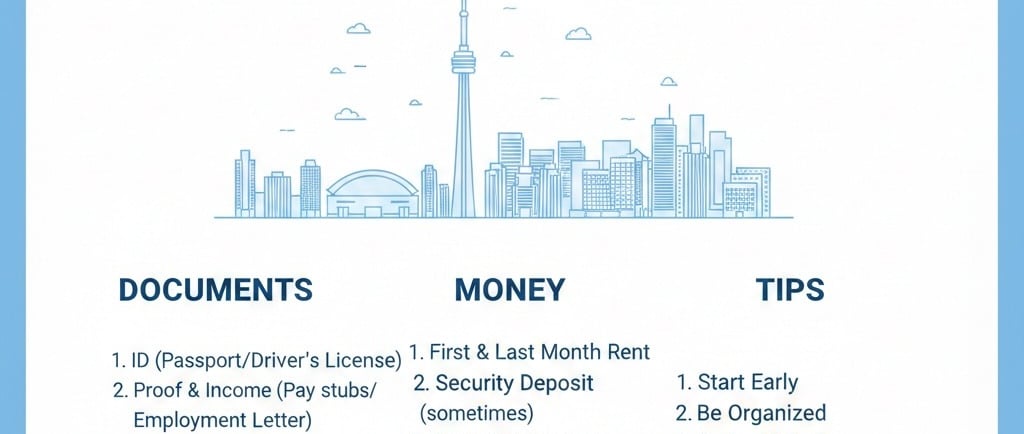
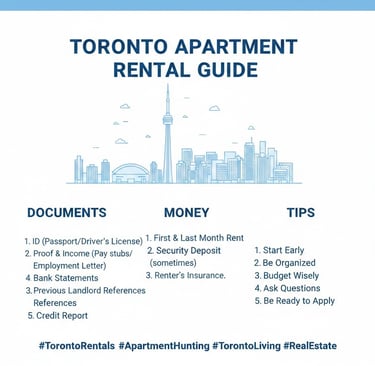
The competitive rental market in Toronto makes finding and securing an apartment challenging. Whether you're a first-time renter, newcomer, or relocating within the city, being prepared with the right documents, understanding upfront costs, and following smart strategies can significantly improve your chances of success.
This guide breaks down the essentials for renting an apartment in Toronto, based on common practices and Ontario's Residential Tenancies Act (RTA) rules.
### Required Documents for Rental Applications
Landlords and property managers in Toronto typically request a standard package to verify your identity, income stability, rental history, and financial responsibility. Have these ready (often digitally scanned) to submit quickly—many listings receive dozens of applications within hours.
1. Government-Issued ID
A passport, driver's license, or other photo ID is almost always required for identity verification.
2. Proof of Income
Recent pay stubs (usually the last 2–3), an employment letter from your employer stating your position, salary, and start date, or equivalent for self-employed individuals (e.g., Notice of Assessment or business records).
3. Bank Statements
Recent statements (often 2–3 months) to demonstrate financial stability and consistent cash flow.
4. Previous Landlord References
Contact information for past landlords (or current if applicable) to confirm your rental history, on-time payments, and property care.
5. Credit Report
A full credit report (commonly from Equifax or TransUnion) is frequently requested to check your credit history and score. Some landlords run the check themselves, but having your own copy ready speeds things up.
Additional items sometimes requested include rental application forms, references from employers or personal contacts, or proof of renter's insurance (more on that below).
Pro tip: Organize everything in a single PDF folder or use rental platforms that allow direct uploads. A complete, professional package often gets priority in Toronto's fast-moving market.
### Upfront Costs and Money Matters
Under Ontario law, landlords cannot collect traditional security deposits for damages or cleaning—those are illegal. Instead, the focus is on rent-related payments:
1. First and Last Month's Rent
This is the most common upfront requirement. You pay the equivalent of two months' rent at the start: the first covers your initial month of occupancy, and the "last" acts as a rent deposit applied to your final month when you move out. The landlord must pay you annual interest on this last month's deposit (currently aligned with Ontario's rent increase guideline, around 2.5% in recent years).
2. Security Deposit
Separate damage deposits are not permitted under the RTA. Any attempt to collect one beyond the last month's rent could be challenged.
3. Renter's Insurance
While not always mandatory upfront, most leases require tenants to carry renter's insurance (covering personal belongings and liability). Landlords often ask for proof of a policy before handing over keys—expect to budget $15–$30/month depending on coverage.
Budget for these plus potential application fees (if charged), moving costs, and utilities setup. Aim to have at least 2–3 months' rent saved beyond the upfront payments.
### Practical Tips for Success in Toronto's Rental Market
The market remains competitive, especially in popular neighborhoods, so maximize your edge:
1. Start Early
Begin searching 1–2 months before your desired move-in date. Good units vanish quickly—set alerts on sites like Realtor.ca, condos.ca
2. Be Organized
Prepare your document package in advance. Respond promptly to inquiries and viewings.
3. Budget Wisely
Follow the guideline that rent should not exceed ~30–35% of your gross monthly income. Factor in utilities, transit, and groceries when calculating affordability.
4. Ask Questions
During viewings or communications, inquire about utilities inclusion, parking, laundry, building rules, and lease terms. Clarify pet policies, maintenance response times, or any condo restrictions.
5. Be Ready to Apply
Have funds available for deposits and be prepared to submit applications on the spot. In hot markets, hesitation can mean losing the unit.
Bonus advice: Familiarize yourself with your rights under the Ontario Residential Tenancies Act via the Landlord and Tenant Board website. Know that rent increases are regulated, and illegal clauses (e.g., no-pets bans in most cases) can be challenged.
Renting in Toronto can feel overwhelming, but preparation turns the odds in your favor. Good luck in your search—your next home is out there!
#TorontoRentals #ApartmentHunting #TorontoLiving #RealEstate
Connect
Say goodbye to repetitive tasks today.
Call
hello@catsaservices.com
© 2025. All rights reserved.